
Fitness is at the center of what we do.
To Tilla Fit, fitness isn’t optional.
It’s something that every person needs.
Over the past year, we shared 52 reasons WHY people need fitness.
Now we shift to the next question.
HOW do you start?
HOW do you stay consistent?
HOW do you build a lifestyle that lasts?
HOW do you get results?
Over the next 52 weeks, we’ll answer those questions.
Here is week 20 of 52 on HOW to approach fitness.
“How to Press”
Last week, we talked about one of the most important movements your body can perform.
The Squat.
This week, we’re moving to the upper body and introducing another fundamental movement.
The Press.
Think about how often you push something throughout your day.
Pushing yourself off the floor.
Opening a heavy door.
Putting luggage into an overhead compartment.
Pushing a lawn mower.
Placing something on a high shelf.
All of these activities require some variation of pressing.
And just like squatting, our ability to perform these movements confidently becomes increasingly important as we age.
Why Everyone Should Be Pressing
Pressing movements primarily strengthen our chest, shoulders, and triceps.
Depending on the exercise, they also challenge our core, coordination, and ability to stabilize our bodies.
Developing strength through these muscles helps us perform everyday tasks, maintain independence, and build a strong, capable upper body.
Step 1: Understand Different Pressing Variations
We can simplify pressing into two primary categories.
Horizontal Pressing
Think about pushing something away from your chest.
Push-Ups.
Dumbbell Bench Press.
Barbell Bench Press.
These movements primarily challenge your chest, shoulders, and triceps.
Vertical Pressing
Think about pushing something overhead.
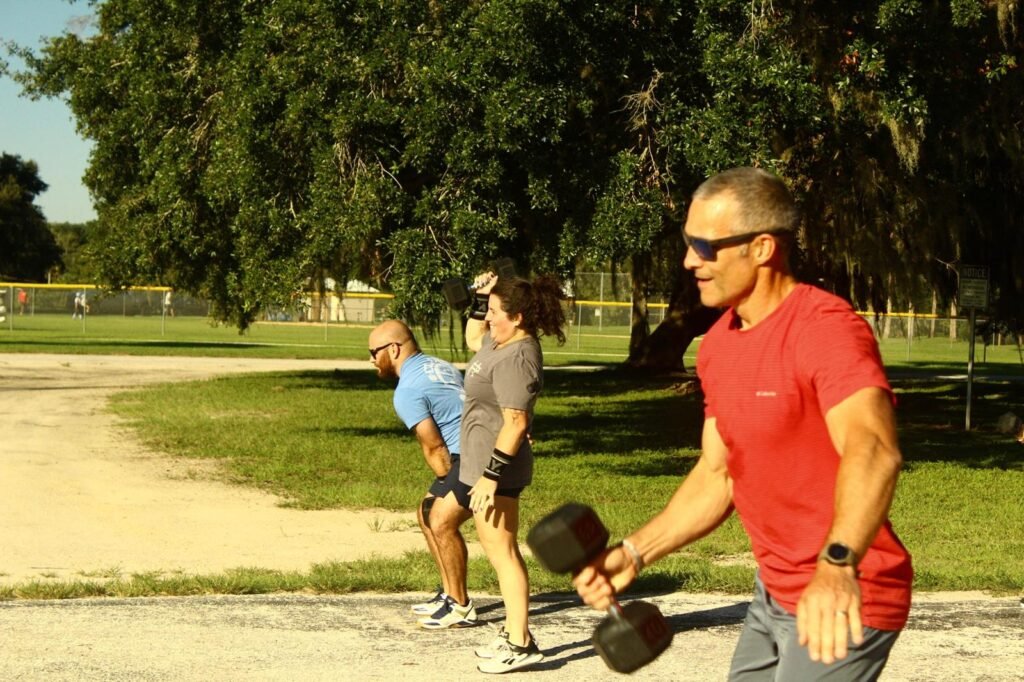
Dumbbell Strict Press.
Barbell Strict Press.
Push Press.
These movements place greater emphasis on your shoulders and triceps while challenging your ability to stabilize your torso.
Both categories deserve a place in a well-rounded training program.
Step 2: Learn The Push Up
One of our favorite places to start is the Push-Up.
Why?
Because you don’t need any equipment, and there are countless ways to adjust the difficulty.
Here’s how to perform it:
1. Find Your Starting Position
Place your hands slightly wider than shoulder-width apart.
Extend your legs behind you and establish a strong plank position.
2. Brace Your Body
Tighten your stomach and glutes.
Think about maintaining a straight line from your shoulders through your hips and ankles.
3. Lower Yourself
Bend your elbows and lower your chest toward the ground.
Keep your elbows by your side or slightly off the body.
4. Press Away
Push through your hands until your arms are extended.
Maintain control of your body throughout the movement.
Step 3: What If You Can’t Perform a Push-Up?
Here’s something we remind our members of all the time.
You don’t need to perform the hardest variation of a movement to get stronger.
Maybe a traditional Push-Up is currently too challenging.
That’s okay.
Start with an Incline Push-Up, or Knee Push Up, or McKenzie Push Up
Place your hands on a sturdy elevated surface, such as a bench or countertop.
Perform the same movement while keeping your body straight.
The higher your hands, the easier the movement generally becomes.
As your strength improves, gradually lower the height of your hands until you’re ready to perform Push-Ups from the floor.
Step 4: How Do You Make Pressing More Challenging?
Once you’ve developed confidence with the basic movements, we can begin introducing additional resistance and variations.
Here are a few of our favorites.
Dumbbell Bench Press
Lie on a bench with a dumbbell in each hand.
Keep your feet planted, lower the dumbbells with control, and press them upward.
This allows you to progressively strengthen your chest, shoulders, and triceps.
Dumbbell Strict Press
Now let’s move overhead.
Start with a dumbbell in each hand at shoulder height.
Brace your torso and press the weights overhead without using your legs to help.
Lower the dumbbells with control.
This develops shoulder strength while challenging your ability to stabilize your body.
Barbell Strict Press
Once you’re comfortable pressing overhead, you can introduce a barbell.
Start with the bar at your shoulders.
Brace your stomach and glutes.
Press the bar overhead, moving your head slightly out of the way as the bar travels upward.
Finish with the bar balanced over your body, then lower it with control.
This is one of our favorite movements for progressively developing upper-body strength.
Push Press
Now we’re introducing a little help from the lower body.
Start with the weight at your shoulders.
Bend your knees slightly, then quickly extend your legs to help drive the weight overhead.
Finish the press with your arms.
The Push Press combines lower-body power with upper-body pressing strength.
Step 5: What If Pressing Bothers Your Shoulders?
Not every pressing movement is going to feel comfortable for every person.
Some people struggle with overhead mobility.
Others experience discomfort during Push-Ups or Bench Presses.
That doesn’t necessarily mean you should stop training your upper body.
It means you may need to adjust the exercise.
Try a lighter weight.
Reduce your range of motion temporarily.
Use dumbbells instead of a barbell.
Or choose a different pressing angle.
If a movement causes persistent or worsening pain, seek guidance from a coach.
The goal is to find movements you can perform comfortably and progressively strengthen over time.
The Tilla Fit Movement Library
We’re continuing to build our free Movement Library on YouTube!
We’ve organized demonstrations by movement category, including a collection dedicated to pressing.
From Push-Ups and Dumbbell Presses to Barbell Presses and more advanced variations, we’re building a resource you can use to learn new movements and improve your technique.
This Week’s Challenge
Find five minutes and test your pressing strength.
Start with 10 Push-Ups.
If you can’t perform them from the floor, find an elevated surface that allows you to complete 10 quality repetitions.
Then grab a pair of light dumbbells and perform 10 Strict Presses.
Pay attention to the difference between pressing horizontally and vertically.